

What was verified, against which statement, at which commit. A registry and trust gate for Lean 4 formalization packages. One append-only registry says which packages exist, who is working on each one, and what evidence binds a package to a verified commit. Nothing becomes public without two receipts, and the second one is re-derived from bytes.
Source and issues: https://github.com/lean-pkg/lean-pkg. License: Apache-2.0. Machine-readable entry: llms.txt.
Start here: Tutorial: Dynkin’s π-λ theorem, end to end takes one textbook theorem from its statement to a verified page on your own machine, and explains each idea (statement and proof, the kernel, axioms, the comparator, receipts, the gate, the page) where it is first needed. Lean checks every step; you check the statement.
Choose your track
lean-pkg leads to one of two final products, and the page certifies each one:
- Track P, a paper: an arXiv or journal paper whose results are formally verified. The page maps every numbered result of the paper to Lean, says which are not formalized, and is anchored to a posted version. Start with Develop a paper with its Lean companion.
- Track L, a Lean library: a reusable library, published on Reservoir or
upstreamed to Mathlib. The page certifies the library’s main results
(
kind: library). Start with A library with no manuscript.
Two tracks maps the commands to each track, gives each its success gate, and lists what is still missing.
Choose your door
| You are | Start with |
|---|---|
| a mathematician who wants a verified page now | Quickstart: lean-pkg new, two receipts, the gate and the page on your own machine, no lab account (about 6 minutes measured, Mathlib included) |
| new here | Start here: the reading path, then the sample workflow |
| evaluating it | Motivation and the FAQ |
| writing a paper with a Lean companion | Develop a paper with its Lean companion: intermediate checkpoints, reuse, a coverage map |
| writing the public README of a companion | The verification page: lean-pkg coverage check and lean-pkg page --write/--check render, from data, each result with the paper’s statement beside the Lean statement, what the checks establish, the receipts and the credits |
| using the tool | How to, the command reference (every command and subcommand, with examples), the CLI overview (global flags) and Prior-art search |
| refereeing or auditing a package | Trust model: what each artifact certifies, what it does not, and how to re-verify a page yourself; then Receipts and trust, The comparator tier, formalization.yaml, The index, Lifecycle |
| adding the comparator tier to your package | Add the comparator tier to an existing package, step by step |
| joining someone’s package | scripts/bootstrap-collaborator.sh OWNER/PACKAGE, then Add the comparator tier to an existing package |
| about to publish | Scan for private strings, a fresh public history for a paper-incubated package, and the publish checklist, Reservoir and Palomar |
| publishing the Lean part of a paper repository | lean-pkg-extract plan: plan a standalone public Lean-verification repository from a mixed TeX+Lean repository, every file traced to a blob of one commit, private material default-denied (P1: plan only; write comes next) |
| writing a negative test (a file that must fail) | Negative tests that fail for the right reason: python3 -m lean_pkg.lean_diag LOG --error-code CODE checks that a Lean log holds exactly one error, the expected one, coded or uncoded |
| auditing a constant two modules both declare | Constants that two modules both declare: python3 -m lean_pkg.dup_constants --project DIR MOD lists every name in more than one module’s constant table, with its owners and the env.find? winner, and refuses any duplicate that is not exactly equal |
| teaching or self-checking an exercise | lean-exercise check: judge a Solution.lean against a Challenge.lean with lake comparator, sandboxed, no registry |
| checking a machine | comparator host-check before a long comparator run |
| declaring or searching results | claims.yaml and lean-pkg search, and formalization.yaml |
| testing it from scratch | Stranger test: run it from the docs alone and record what happened |
| a coding agent | Using lean-pkg with agents, llms.txt, and the agent skills |
| contributing | CONTRIBUTING, GOVERNANCE and MAINTAINERS; a format or command change starts as a design proposal; a soundness bug goes privately by SECURITY |
In one paragraph
A package moves through
scratch → active → gate-pending → verified-private → public → upstreamed. The move to verified-private requires a lower-tier
receipt (lake build, sorry scan, #print axioms, bound to one commit). The
move to public additionally requires a comparator receipt: trusted
Challenge.lean statements checked against untrusted Solution.lean proofs
by leanprover/comparator, with every proof replayed in the independent
nanoda kernel. promote re-derives that PASS from file hashes and log
lines before it flips the GitHub repository to public, which cannot be
undone in practice.
Quick start
The shortest path, from pip install to a verified page with no lab account, is the
Quickstart. The shared-registry setup for a group:
Install the CLI once, then use one private Git-backed registry to coordinate many independent research repositories:
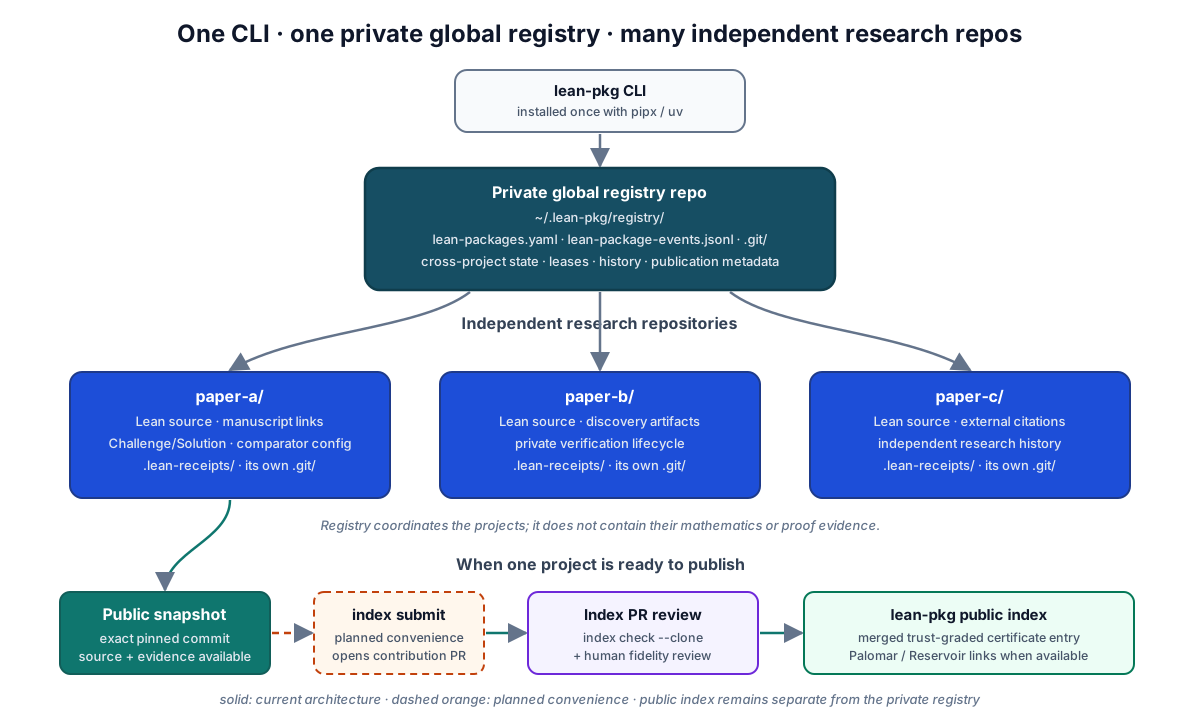
pipx install git+https://github.com/lean-pkg/lean-pkg.git
mkdir -p ~/.lean-pkg/registry
git -C ~/.lean-pkg/registry init
lean-pkg --registry ~/.lean-pkg/registry/lean-packages.yaml registry init
# ~/.lean-pkg/registry is the default registry location: no LEAN_PKG_REGISTRY needed
lean-pkg register my-proof --repo git@github.com:you/my-proof.git --path src/my-proof
Continue with Getting started for the initial registry
commit, receipts, and promotion dry run. A future lean-pkg registry init --global
will automate the registry bootstrap; it is not implemented yet.
Pages
- Quickstart: from
pip installto a verified page, for a new package (lean-pkg new) or an existing one. - Start here: the newcomer path, including the Lean reading list.
- Sample workflow: a real package from registration to a promotion dry run, with the workflow diagram: the seven shared steps and the paper and library tracks.
- Develop a paper with its Lean companion: check intermediate results while the paper evolves, record checkpoints, reuse unchanged results, keep a coverage map, consolidate several checkpoint packages into one new package.
- FAQ: common questions, including how this differs from Palomar and Mathlib.
- Motivation: the problem this solves and where it is going.
- Getting started: install and a complete worked example.
- How to: task recipes.
- Lifecycle: status enum, transitions, leases.
- Trust model: what each receipt, the page and the index certify and do not, the trusted parties, the threats covered and not, and the steps to re-verify a published page from the public repository alone.
- Receipts and trust: both receipt schemas, the evidence-only descendant rule, and the trust boundary.
- The comparator tier: the Palomar layout, the runner, the host policy, the tool pins.
- formalization.yaml: render the mathlib-initiative v0.4 report Palomar reads from the registry, the comparator configurations and the receipts; derived versus kept keys; placeholders; the audit drift check.
- The verification page:
coverage.yamland the README sectionlean-pkg pagerenders from it, the claims ledger and the receipts; the--checkstaleness and credits gate. - Compute sites: site profiles, the acknowledgment of the cluster that ran the gates, and how to add a site of your own.
- The index: the public catalog of trust-graded packages, its entry schema, and how to add and check an entry.
- Prior-art search: claims files,
lean-pkg searchacross the registry, the index, Loogle, LeanSearch, Reservoir, Palomar and GitHub, and the search record. - Command reference: every command and subcommand on its own page, with its
usage, flags, exit codes,
--jsonkeys and examples; generated from the parser. - CLI overview: the global flags, committed mode, leases, the package record and the exit codes.
- Using lean-pkg with agents: the LLM entry.
- Agent skills: lessons for agents on statement fidelity, evidence and publication, with an installer.
- Decisions: dated records of the choices that shape the tool.
- LTS stacks: dated Lean + Mathlib + lean-pkg combinations that later releases keep working on (first: lts-2026.10).
- Design proposals: how a schema, command-removal or trust-model change is proposed, decided and implemented.
Citation
Releases are archived on Zenodo: the concept DOI
10.5281/zenodo.23272098 resolves to
the latest release, and CITATION.cff lists it with the version DOIs. To cite
a state between releases, cite the repository at a commit:
@software{lean_pkg,
  author  = {Chen, Le},
  title   = {lean-pkg: a registry and trust gate for Lean 4 formalization packages},
  year    = {2026},
  version = {0.18.0},
  url     = {https://github.com/lean-pkg/lean-pkg},
  note    = {commit <sha>}
}
For a verified result, cite the package’s Zenodo version DOI (cut at the
Palomar-registered commit) together with its PALOMAR-… id and version;
see the FAQ.
License
The tool and this documentation are released under the Apache License 2.0. Each verified package carries its own license; the promotion checklist requires one that GitHub can detect.