Install
Python 3.11 or newer. The only Python dependency is PyYAML. Git is a core requirement for package provenance: receipts bind to Git commits and several checks inspect Git ancestry and working-tree state.
pipx install git+https://github.com/lean-pkg/lean-pkg.git
# or
uv tool install git+https://github.com/lean-pkg/lean-pkg.git
# or, from a checkout, for development
python3 -m pip install -e '.[test]'
The repository is public, so the https URL needs no GitHub credentials.
The documentation site is https://lean-pkg.github.io/lean-pkg/; the same
pages are the Markdown files under docs/. lean-pkg doctor exits 1 until
a registry exists (see below); that is expected on a fresh install.
External tools, needed only by some commands:
| Tool | Needed for |
|---|---|
git |
everything that reads a package repository |
gh, authenticated (gh auth login or GH_TOKEN) |
promote and audit; GitHub is only the visibility mirror |
reuse (optional) |
the REUSE lint line of the promotion checklist |
Linux, elan (lean, lake), go, cargo, jq |
lean-pkg receipt comparator. Linux only: the legacy mechanism sandboxes with landrun (Landlock) and the toolchain mechanism with bwrap; macOS is not supported. The toolchain mechanism (Lean v4.35.0-rc2 or later, what Palomar runs) uses the kernels bundled with the toolchain and builds nothing of its own: a first run on a one-theorem project took seconds once the Mathlib cache was in place. The legacy mechanism’s first run builds the pinned comparator tools into ~/.cache/lean-ci-tools (override with TOOLS_DIR): from about 2 minutes on a fast machine to about 25 minutes cold, seconds afterwards. lean-pkg comparator host-check says which mechanisms this machine can run. Budget several GB of disk for the Lean toolchain and the Mathlib cache |
Configuration
| Setting | Meaning |
|---|---|
--registry PATH, then env LEAN_PKG_REGISTRY, then the user-level default ~/.lean-pkg/registry, then ./lean-packages.yaml |
registry file, in that order of precedence; lean-pkg doctor names the one in use ([source: flag\|env\|user-default\|cwd]) |
~/.lean-pkg/registry (base directory: env LEAN_PKG_HOME) |
user-level default: a directory, or a symlink to one, holding lean-packages.yaml, or the registry file itself. Point it at an existing registry repository with mkdir -p ~/.lean-pkg && ln -s /path/to/registry-repo ~/.lean-pkg/registry |
--events PATH, else lean-package-events.jsonl next to the registry |
append-only event log |
LEAN_PKG_NOTIFY_CMD |
optional command run once after a successful publish --yes, message on stdin |
COMPARATOR_RECEIPT_ALLOWED_HOSTS |
comma-separated host names on which lean-pkg receipt comparator may run |
COMPARATOR_RECEIPT_ALLOW_HOST=1 |
explicit override of the host policy (recorded in the receipt) |
SLURM_JOB_ID |
inside a Slurm job the run is always allowed and the job id becomes the receipt job_id |
COMPARATOR_CHECK |
an alternative comparator-check.sh (default: the copy shipped in the package) |
Each package’s local_path is resolved relative to $HOME, so machines that
keep checkouts at the same home-relative place can share one registry.
Absolute paths also work.
Recommended layout: one registry, many projects
Install lean-pkg once and use one shared registry to coordinate many
independent Lean/Git repositories:
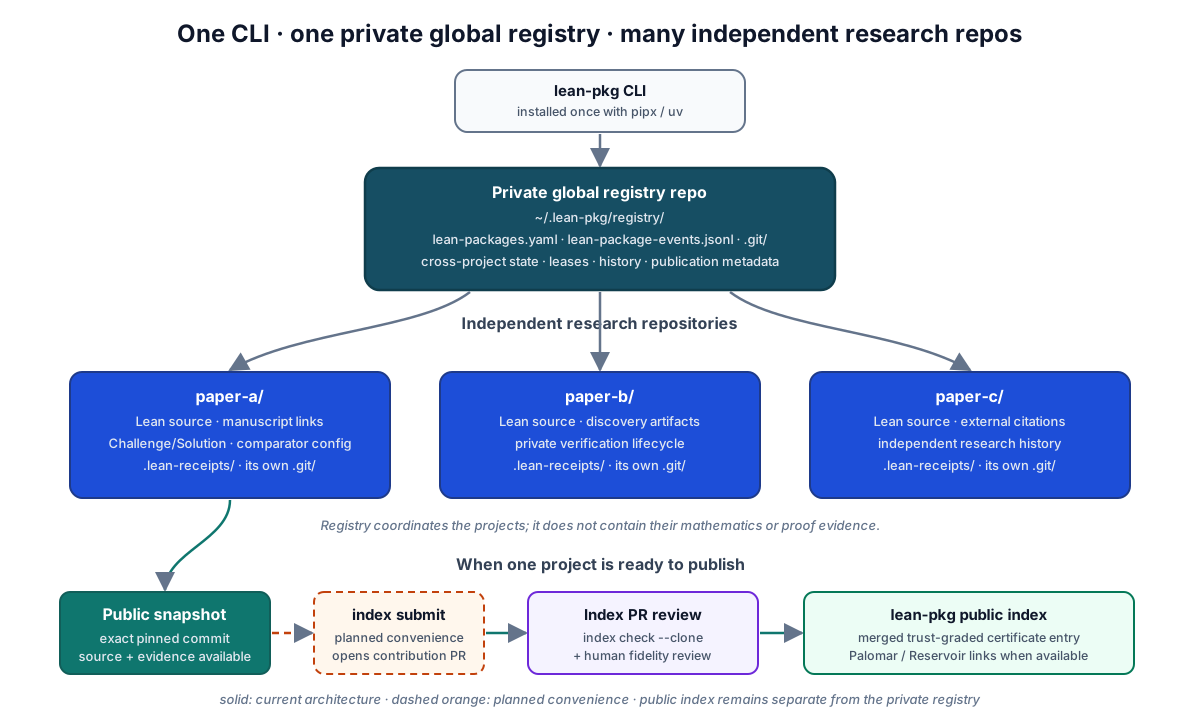
~/.lean-pkg/registry/
  .git/
  lean-packages.yaml
  lean-package-events.jsonl

~/src/
  paper-a/        # independent Git repo
  paper-b/        # independent Git repo
  paper-c/        # independent Git repo
The research repositories hold the mathematics, Lean source, comparator files,
and their own committed .lean-receipts/. The registry repository holds the
cross-project coordination state and append-only event history.
Keep the registry repository private by default. It may contain pre-publication project names, local paths, agent/workspace identifiers, notes, and lifecycle status.
Bootstrap the shared registry today
The current CLI can create the registry files, while Git initialization is done explicitly:
mkdir -p ~/.lean-pkg/registry
git -C ~/.lean-pkg/registry init

lean-pkg --registry ~/.lean-pkg/registry/lean-packages.yaml registry init

git -C ~/.lean-pkg/registry add lean-packages.yaml lean-package-events.jsonl
git -C ~/.lean-pkg/registry commit -m "registry: initialize lean-pkg"

# ~/.lean-pkg/registry is the default registry location: no LEAN_PKG_REGISTRY needed
After that initial commit, modify the registry through lean-pkg, not by
hand, and commit meaningful registry changes as part of your normal coordination
workflow.
A collaborator setting up for one package can run
scripts/bootstrap-collaborator.sh OWNER/PACKAGE instead, which also checks
access, clones and registers the package
(step 0 of the comparator guide).
A proposed future lean-pkg registry init --global will automate this Git-backed
bootstrap and allow a custom registry-repository location. It is described in
the roadmap and is not implemented yet.
Worked example, end to end
This takes a small Lake project from registration to a promotion dry run.
Replace you/my-proof with your repository and src/my-proof with the
path of your checkout under $HOME. my-proof is the package name given
to register; every later NAME is that name, not a path.
1. The project
The finished project looks like this:
~/src/my-proof/
  lean-toolchain        leanprover/lean4:v4.35.0-rc2
  lakefile.toml         requires Mathlib; one library, MyProof
  lake-manifest.json    tracked; pins Mathlib
  .gitignore            ignores .lake/
  LICENSE               an OSI license GitHub can detect (needed by promote, not by the receipt)
  MyProof/Challenge.lean  module MyProof.Challenge: trusted, Mathlib-only statements, proofs replaced by `sorry`
  MyProof/Solution.lean   module MyProof.Solution: the same theorem names and statements, with proofs
  comparator.json
The project must depend on Mathlib (a mathlib entry in
lake-manifest.json; a bare lake new project has none). The Challenge is
written in Mathlib’s vocabulary, and lean-pkg receipt comparator’s toolchain
mechanism, what Palomar runs, fetches Mathlib’s build cache, so the runner
refuses a project without it before judging:
the toolchain mechanism needs a Mathlib dependency (lake-manifest.json has none); add it and run lake update
Add mathlib to the lakefile’s requirements, run lake update and commit
the manifest. A project that knowingly has no Mathlib sets
COMPARATOR_RECEIPT_NO_MATHLIB=1 (see
The comparator tier).
Start from scratch
No project yet? These commands make the one above, with one theorem. Paste
them as they are; my-proof, MyProof and two_mul_le are names you may
change later, consistently.
lean-pkg new my-proof --kind library writes the same files, plus the claims,
coverage, citation, license, REUSE and verify script the Quickstart
uses (without --kind, a paper companion whose coverage.yaml waits for the paper,
pinned to the current LTS stack when one is current).
mkdir -p ~/src/my-proof && cd ~/src/my-proof
git init
echo 'leanprover/lean4:v4.35.0-rc2' > lean-toolchain
printf '/.lake\n' > .gitignore

cat > lakefile.toml <<'EOF'
name = "my-proof"
defaultTargets = ["MyProof"]

[[require]]
name = "mathlib"
scope = "leanprover-community"
rev = "v4.35.0-rc2"

[[lean_lib]]
name = "MyProof"
globs = ["MyProof.+"]
EOF

mkdir -p MyProof
cat > MyProof/Challenge.lean <<'EOF'
module

public import Mathlib

public section

theorem MyProof.two_mul_le (n : ℕ) : n ≤ 2 * n := by
  sorry

end
EOF

cat > MyProof/Solution.lean <<'EOF'
module

public import Mathlib

public section

theorem MyProof.two_mul_le (n : ℕ) : n ≤ 2 * n := by
  omega

end
EOF

cat > comparator.json <<'EOF'
{
  "challenge_module": "MyProof.Challenge",
  "solution_module": "MyProof.Solution",
  "theorem_names": ["MyProof.two_mul_le"],
  "definition_names": [],
  "permitted_axioms": ["propext", "Quot.sound", "Classical.choice"],
  "enable_nanoda": true
}
EOF

lake update
lake exe cache get
lake build MyProof.Challenge MyProof.Solution
git add -A && git commit -m "minimal Challenge/Solution project"
defaultTargets makes a bare lake build build the library (on Lean
v4.35.0, Lake otherwise builds nothing and says “no targets specified and
no default targets configured”).
lake update writes lake-manifest.json and downloads Mathlib (several
GB with its cache); the build ends with Build completed successfully and
one declaration uses `sorry` warning, from the Challenge. Add a LICENSE
before you promote. lake new MyProof math is another start: it writes a
Mathlib lakefile.toml with the library MyProof; put the two files in its
MyProof/ directory and write comparator.json as above. Its own
MyProof.lean and MyProof/Basic.lean have no module header (the
template of Lean v4.35.0-rc2): give them one, as below, or delete them, before
palomar check.
The module header
Both files use Lean’s module system, which Palomar requires of every tracked
.lean file (lean-pkg palomar check NAME reports a file without it as
source.module_required). Three lines carry it:
moduleis the file’s first command; only ordinary comments may come before it.public import Mathlib: the theorem statements mention Mathlib, so the import must be public. A plainimportis private to the module’s implementation, and a statement that uses a name it brings in fails withUnknown identifier.public section…end: in a module a declaration is private unless it is public, andlake comparatorcannot export a private theorem (it stops withConstant ... not found in environment). Writingpublic theoremon each theorem works too.
A definition that a Challenge and its Solution share, and whose body a proof
unfolds, also needs @[expose] (@[expose] public section in the file that
defines it); without it the body is hidden from importing modules and
unfold fails. These forms were checked with lake build and
lake comparator on Lean v4.35.0-rc2. On a toolchain below v4.35.0-rc2,
which Palomar does not accept, leave out module, public section and
end, and write import Mathlib.
An existing project written without the module system can be ported with
lean-pkg palomar port-modules NAME: a dry run prints the diff and the
definitions likely to need @[expose]; --write applies it to a clean
working tree, never committing (CLI reference).
Module names are file paths
A module’s name is its path from the project root: MyProof.Challenge is the
file MyProof/Challenge.lean. A Challenge.lean at the root is the module
Challenge, so a configuration naming MyProof.Challenge while the file sits
at the root fails at the build stage:
error: no such file or directory (error code: 2)
  file: .../my-proof/MyProof/Challenge.lean
Every module must also belong to a library in lakefile.toml, or
lake build MyProof.Challenge fails with unknown target
(lean-pkg receipt comparator checks this with lake --no-build build at the end of
its checkout stage, before the cache download and the build). One [[lean_lib]]
whose globs cover the directory, as above, is enough. For several
challenges, keep them under one directory, for example
Audit/<Name>/Challenge.lean with [[lean_lib]] name = "Audit" and
globs = ["Audit.+"]; the configuration then names the modules
Audit.<Name>.Challenge and Audit.<Name>.Solution.
The comparator tier
explains what goes in each file.
comparator.json
comparator.json uses the Palomar layout. Write every field:
| Field | Meaning |
|---|---|
challenge_module, solution_module |
the two module names, as above |
theorem_names |
the theorems to compare, fully qualified; at least one |
definition_names |
Challenge definitions whose body the Solution may supply (compared by name and type only); [] when there are none, as here. A non-empty list needs a human sign-off in lean-pkg-signoff.json beside the configuration, never inside it (the comparator tier) |
permitted_axioms |
a subset of ["propext", "Quot.sound", "Classical.choice"] |
enable_nanoda |
true: also replay in the nanoda kernel |
Write "definition_names": [] even when it is empty: the receipt records
the list, and lean-pkg comparator --check compares it with the file.
Several configurations may be declared, as comparator*.json at the project
root or as comparator/config*.json. Every one of them must pass. See the
comparator tier for the details.
2. A registry and a package entry
Assume the shared registry from the setup above:
# ~/.lean-pkg/registry is the default registry location: no LEAN_PKG_REGISTRY needed

lean-pkg register my-proof --repo git@github.com:you/my-proof.git \
    --path src/my-proof --upstream-target palomar
lean-pkg lease claim my-proof --workspace laptop --agent alice --reason "comparator tier"
lean-pkg update my-proof --agent alice --status gate-pending --reason "lower-tier check submitted"
register prints:
my-proof: registered (status=active, visibility=private, toolchain=leanprover/lean4:v4.35.0-rc2, pin=065356127b)
After this bootstrap, change the registry only through lean-pkg. Never
edit the YAML by hand.
3. The lower-tier receipt
Run your usual checks at the commit you want to certify (lake build, a
sorry scan, #print axioms over the exported theorems), freeze the report,
and write a receipt JSON. lean-pkg validates the receipt but does not
produce it:
{
  "commit": "<40-hex HEAD of ~/src/my-proof>",
  "lean_toolchain": "leanprover/lean4:v4.35.0-rc2",
  "mathlib_rev": "<full Mathlib rev from lake-manifest.json>",
  "sorry_count": 0,
  "axioms": ["propext", "Quot.sound", "Classical.choice"],
  "report_sha256": "<sha256 of the frozen report>",
  "job_id": "slurm-123456",
  "checker": "lake build + sorry scan + #print axioms",
  "generated_at": "2026-10-05T12:00:00+00:00"
}
4. The comparator receipt
From your checkout (here ~/src/my-proof), with a clean working tree and
after lake exe cache get:
COMPARATOR_RECEIPT_ALLOWED_HOSTS="$(hostname)" comparator-receipt
Expected output:
mechanism: toolchain
comparator-receipt: stage 01-checkout: ok (dependency checkout per lake-manifest.json)
comparator-receipt: stage 02-cache-get: ok (Mathlib build cache)
comparator-receipt: stage 03-build: ok (build of MyProof.Challenge, MyProof.Solution)
comparator-receipt: 1 slot(s) in 1 config(s), 1 judge invocation(s), 1 at a time, mechanism toolchain
...
con-ron kernel accepts the solution
nanoda kernel accepts the solution
Lean default kernel accepts the solution
Your solution is okay!
slot 1/1 MyProof.two_mul_le done in 9.4s (1/1 done)
comparator-receipt: stage 04-comparator: ok (1 config(s) accepted (toolchain; 1 slot(s)))
comparator-receipt: stage 05-receipt: ok (.lean-receipts/cb3d68a21454-comparator.json)
comparator receipt written: .../my-proof/.lean-receipts/cb3d68a21454-comparator.json (1 config(s), commit cb3d68a21454, host policy: host <host> listed in COMPARATOR_RECEIPT_ALLOWED_HOSTS)
commit .lean-receipts/ in this repo, then record it:
  lean-pkg comparator attach <name> --receipt .../my-proof/.lean-receipts/cb3d68a21454-comparator.json
  (or at gate time: lean-pkg gate <name> --receipt R.json --comparator .../my-proof/.lean-receipts/cb3d68a21454-comparator.json)
This is the toolchain mechanism’s output, the default on Lean v4.35.0-rc2
or later (shape of a real run on 2026-10-10, shortened). Both mechanisms
print Your solution is okay! for each accepted configuration
(mechanisms); the legacy check prints
PASS comparator.json and All 1 comparator configuration(s) accepted.
instead of the stage lines. The line to look for is
comparator receipt written:, which appears only when every configuration
is accepted. COMPARATOR_RECEIPT_ALLOWED_HOSTS="$(hostname)" allows this
host; without it, outside Slurm, the run refuses by design. A
WARN: soft stack limit is 8 MiB line near the start is advice for large
modules; a small project can ignore it.
Inside a Slurm job the host policy is satisfied automatically. The runner
writes .lean-receipts/<commit12>-comparator.json and one
.lean-receipts/<commit12>-comparator-<cfgname>.log per configuration. If
any configuration fails, it writes nothing.
5. Gate with comparator evidence
lean-pkg gate my-proof --receipt /path/to/receipt.json \
    --comparator .lean-receipts/cb3d68a21454-comparator.json
Expected output:
receipt copied to .../my-proof/.lean-receipts/cb3d68a21454-slurm-123456.json — NOT committed there; commit it in the verified repo yourself
comparator receipt already present at .lean-receipts/cb3d68a21454-comparator.json (not re-copied)
my-proof: gate-pending -> verified-private (commit cb3d68a21454) with comparator evidence .lean-receipts/cb3d68a21454-comparator.json
Now commit the evidence in the package repository:
git add .lean-receipts && git commit -m "evidence: receipts for cb3d68a21454"
This commit changes only .lean-receipts/, so it is an evidence-only
descendant of the certified commit, and both receipts stay valid. See
Receipts and trust.
6. Re-check the comparator evidence
lean-pkg comparator my-proof --check --receipt .lean-receipts/cb3d68a21454-comparator.json
Expected output:
my-proof: comparator receipt valid at commit cb3d68a21454 (1 config(s)) — not recorded (--check)
--check re-derives the PASS from bytes and records nothing. It works at any
status, so you can validate a receipt the moment the runner wrote it.
7. Promotion dry run
lean-pkg publish my-proof --yes --dry-run
Expected output:
promotion checklist for my-proof (~/src/my-proof):
  ✓  reuse lint passed
  ✓  LICENSE/COPYING present at repo root
  ✓  lake-manifest.json tracked at HEAD
  ✓  gate receipt bound to HEAD 148818d4c635 (evidence-only descendant of cb3d68a21454 (+3 evidence file(s)))
  ✓  gate receipt .lean-receipts/cb3d68a21454-<job>.json tracked at HEAD (1 file(s))
  ✓  comparator PASS bound to HEAD 148818d4c635 (1 config(s): config and log bytes match the receipt, PASS line present; not re-run)
  ✓  comparator receipt .lean-receipts/cb3d68a21454-comparator.json and its 1 log(s) tracked at HEAD (2 file(s))
  ✓  HEAD 148818d4c635 contained in origin/main (local refs; nothing fetched)
  ✓  gh visibility matches registry (private)
  ✓  automation disclosure not required (upstream_target=palomar)
WARNING: a GitHub private→public flip is effectively ONE-WAY — ...
DRY RUN — nothing changed. Re-run with --yes to execute.
lean-pkg publish my-proof --yes performs the flip
(gh repo edit --visibility public). Forks, clones, and caches stay public
afterwards, so treat it as irreversible.
Next: How to for task recipes, or the command reference.