Two tracks: a verified paper, or a reusable Lean library
One gate, two products: a verified paper or a reusable library.
Status: design proposal, 2026-10-17; its four decisions were taken the same
day (Decisions, decision 0007).
Nothing here changes a format; the one change it ships is that status
reports which product a package’s page certifies (below). The gap list at
the end is the work it proposes.
“Wave” refers to the maintainer roadmap’s five steps: 1, a first outside
user (lean-pkg new and a quickstart); 2, simplify to 1.0 and freeze the
formats (1.0 command tree); 3, receipts from any CI
runner or cluster; 4, a published trust model an outsider can re-verify
against; 5, open governance.
lean-pkg serves two kinds of author, and each has its own final product.
| Track P, paper | Track L, library | |
|---|---|---|
| Final product | a paper (arXiv, then a journal) whose results are formally verified | a reusable Lean library, upstreamed to Mathlib or published as a public package listed on Reservoir |
| What the page certifies | the paper’s numbered results: which are formal, which take named inputs, which are not formalized | the library’s main results, stated by their Lean declarations |
coverage.yaml |
kind: paper (the default), with a manuscript pinned to a posted version |
kind: library, no manuscript (released in 0.9.0) |
| What “fidelity” means | the Lean statement says what the paper says | the Lean statement is the result; what matters next is that it stays stable for downstream users |
| Where it ends | a citable companion (DOI, optionally a Palomar entry) beside the paper | a tagged release on Reservoir, and Mathlib PRs merged for the general parts |
The two tracks share most of the machinery. They differ in what the page is anchored to and in what happens after the public flip.
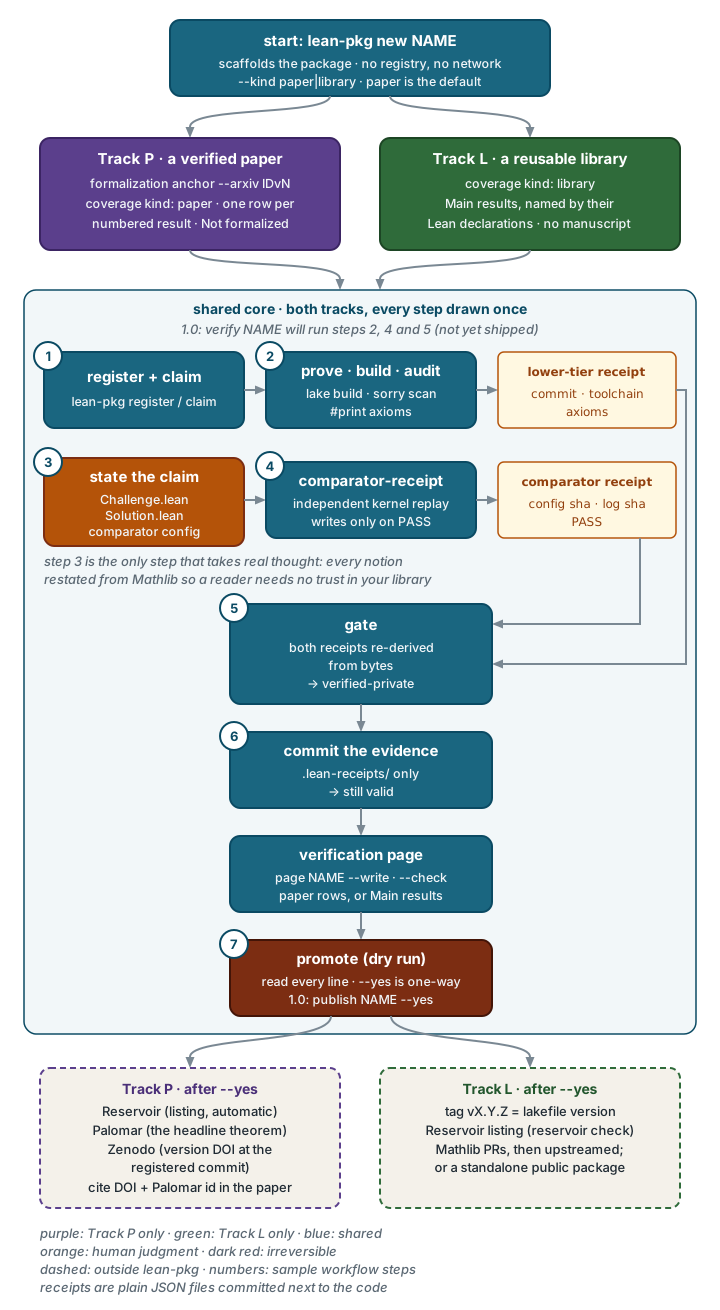
The diagram is the sample workflow’s, extended: the
fork after new and the fork after --yes are the only track-specific steps,
and the shared core is drawn once.
A word on naming: the package record already has a field called track, the
DOI track (palomar or doi-only, see the CLI reference). This
document says “Track P” and “Track L” for the two product tracks. The tool
does not add a field for them: kind in coverage.yaml already says paper
or library, and lean-pkg status now reports it as scope.product
(product: library, the page certifies a library's main results ..., or
product: not declared (...) when no coverage.yaml is committed at HEAD).
A package record never stores it, so it cannot drift from the file the page
is rendered from.
What exists today, by track
Checked against the source of 0.9.0. A module listed under one track can be used by the other; the column says whose final product needs it.
Shared core
| Feature | Module | Role in both tracks |
|---|---|---|
| Registry, lifecycle, leases, history | cli.py |
scratch → active → gate-pending → verified-private → public → upstreamed |
| Lower-tier receipt (build, sorry 0, axioms) | receipt.py, receipt_systemd.py |
evidence bound to one commit |
| Comparator receipt (Challenge vs Solution, kernel replay) | comparator_receipt.py, comparator_stage.py, comparator_config.py, comparator_types.py, holes.py |
statement checking |
| Gate and docs-only descendants | cli.py (gate), build_scope.py, lake_hygiene.py |
which commit is verified |
| Claims and the ledger | claims.py, claims_mark.py, ledger.py |
one row per Lean result, and why it is or is not verified |
| Coverage and the verification page | coverage.py, page.py, page_html.py |
the README block, rendered from data, either kind |
| Headline configuration | headline.py |
the main results among many compared theorems |
Product kind in status |
cli.py (status_product, scope.product) |
which track a package is on, read from coverage.yaml at HEAD |
| Publish checklist, promote, next step | publish.py, cli.py (promote), next_step.py |
the path to public |
| Public-safety scan, fresh-history export | public_safety.py, fresh_repo.py, export_paths.py |
nothing private goes public |
| Index (field-curated catalogue) | index.py |
re-derives every claim from bytes at a pin |
| Search before building, prior-art records | search.py, prior_art.py, adapters/ |
Mathlib, Reservoir, Palomar, GitHub |
| Credits and citation | page.py, formalization.py, CITATION.cff, doi-minted events |
lean-pkg credit, compute acknowledgement, DOI |
| Reservoir checks | reservoir.py |
listing criteria; central to Track L, used by P companions too |
| Palomar readiness and bundle | palomar_check.py, palomar.py, port_modules.py, formalization.py |
Palomar accepts both (its sources allow an original proof), so shared; most P companions go there |
Both tracks sit on top of Lean’s own checks (lake check, lake comparator
and --paranoid, in Lean v4.35.0) rather than beside them; the trust model
says how, in
Positioning against Lean’s own checks.
Track P only
| Feature | Module | What it does |
|---|---|---|
| Paper rows and Not formalized | coverage.py (kind: paper), page.py |
one row per numbered result, classed same-assumptions, inputs-supplied or outside |
| Manuscript anchor | anchor.py (formalization anchor) |
binds coverage to an arXiv version and its e-print SHA-256; refuses a library coverage |
| Claims rebase | rebase.py (claims rebase) |
moves rows from one manuscript version to the next; leaves a library coverage alone |
| Manuscript findings | claims.py (manuscript_findings, statement_basis) |
records a misprint or proof gap found by formalizing |
| Unposted drafts | coverage.py (--allow-private-manuscript) |
a private draft stays kind: paper, never library |
| Extraction from a mixed TeX and Lean repository | extract.py (lean-pkg-extract plan) |
plans a public Lean repository out of a paper repository (plan only) |
| Paper metadata | record fields paper, source_paper |
credited in formalization.yaml |
Track L only
| Feature | Module | What it does |
|---|---|---|
| Library coverage | coverage.py (kind: library), page.py |
Main results table, no manuscript anywhere on the page |
| Mathlib as upstream target | cli.py (upstream_target: mathlib, automation) |
promote requires an AI-disclosure note for a Mathlib target |
| Mathlib PR evidence | cli.py (record … mathlib-pr-opened / mathlib-pr-merged) |
a merged PR is the evidence for public → upstreamed |
| Next step after public | next_step.py |
asks for the Mathlib PR URL when the target is Mathlib |
Claim kind library |
claims.py |
a claim that names a whole library |
Outside both tracks: lean-exercise (exercise.py), the registry-free judge
for teaching. It keeps its own path.
Track P, end to end
The paper is the product; the companion certifies it. In the approved 1.0 tree (1.0 command tree has the full table) the path is the five shared verbs:
lean-pkg new DIR                                           # kind paper is the default
lean-pkg formalization anchor NAME --arxiv IDvN --fetch --write
lean-pkg verify NAME                                       # receipt, comparator receipt, gate
lean-pkg page NAME --write
lean-pkg publish NAME --yes                                # then record doi-minted; optionally palomar prepare
Until verify ships, the same path with the commands of the next release
after 0.10.0, whose new writes the paper track by default (coverage.yaml
of kind: paper, manuscript.version: unposted and FILL-ME markers that
coverage check refuses until the author names the paper and its results;
0.10.0’s new scaffolds a library only):
lean-pkg new my-paper-lean                                   # kind paper; fill in coverage.yaml's FILL-ME markers
lean-pkg register my-paper-lean --repo URL --path DIR
lean-pkg formalization anchor my-paper-lean --arxiv IDvN --fetch --write
lean-pkg gate my-paper-lean --receipt R.json                 # lower tier; then comparator-receipt and
lean-pkg comparator my-paper-lean --receipt C.json           #   the comparator receipt on the same commit
lean-pkg page my-paper-lean --write && lean-pkg publish my-paper-lean --dry-run
lean-pkg promote my-paper-lean --yes                         # then tag, record doi-minted, optionally palomar prepare
Success gate for Track P (all checkable by an outsider):
coverage.yamliskind: paperand anchored to a posted arXiv version (eprint_sha256recorded); nounpostedmanuscript on a public page.- Every numbered result of the paper has a row; every
outsiderow appears under Not formalized; everyinputs-suppliedrow names its inputs. - Every theorem the gate-bound comparator receipt compares belongs to a row
(enforced by
coverage checktoday). page --checkpasses at the tagged commit, and the tag has a DOI.- Someone outside the authors’ group re-verifies the page from the tag (the wave 4 gate).
Track L, end to end
The library is the product; the page certifies its main results and the release tells downstream users what they can depend on. In the 1.0 tree:
lean-pkg new DIR --kind library                        # or `new --adopt DIR` for an existing repository
lean-pkg verify NAME
lean-pkg page NAME --write                             # Main results, no manuscript
lean-pkg publish NAME --yes
lean-pkg reservoir check NAME                          # then tag vX.Y.Z, record reservoir-listed; Mathlib:
                                                       #   record mathlib-pr-opened / -merged, then upstreamed
With today’s commands, where new NAME --kind library scaffolds a library
(coverage.yaml with kind: library, one claim, a comparator config; no
registry touched; plain new NAME in 0.10.0):
lean-pkg new my-lib --kind library && lean-pkg register my-lib --path my-lib   # or register an existing repository
lean-pkg claims sync my-lib && lean-pkg coverage check my-lib
lean-pkg gate my-lib --receipt R.json && lean-pkg comparator my-lib --receipt C.json
lean-pkg page my-lib --write && lean-pkg reservoir check my-lib && lean-pkg publish my-lib --dry-run
lean-pkg promote my-lib --yes                          # then tag vX.Y.Z, record reservoir-listed,
                                                       #   mathlib-pr-opened / -merged for the upstreamed parts
Success gate for Track L, today and proposed:
coverage.yamliskind: library; every main result is compared (today).- Zero
sorry, axioms within the allowed set (today). - Proposed: the library passes its lint driver (
lake lint) and the Mathlib style linters at the gated commit, recorded like a receipt. - A version tag
vX.Y.Zwhose number equals the lakefileversion, and a Reservoir listing recorded (record … reservoir-listed). - Either a Mathlib PR merged for every declaration marked for upstreaming, or an explicit decision that the library stays a standalone package.
Track L gaps
The library track is younger: until 0.9.0 a library could not have a page at all. What a library author needs that lean-pkg lacks, with the Lean and Mathlib facts each item relies on.
Mathlib readiness. Mathlib requires a docstring on every definition and
major theorem; the docBlame linter lists definitions without one and
#lint runs the default linters (documentation style).
Lines are at most 100 characters and each file opens with a copyright header,
imports, then a /-! … -/ module docstring (style guide);
names follow the naming conventions.
Mathlib’s lakefile enables linter.mathlibStandardSet and linter.style.header
and defines lake exe lint-style for text-based style linters; Batteries
ships runLinter as its lintDriver (mathlib4 lakefile,
batteries lakefile).
Lake runs a package’s lint driver with lake lint, and a driver may come from
a dependency as <pkg>/<name> (Lake README):
Mathlib itself sets lintDriver := "batteries/runLinter", so a library that
depends on Mathlib can run the same environment linters with one line.
lean-pkg checks none of this. lean_scan.py already attaches docstrings to
declarations without running Lean, so a static readiness report is cheap; the
linter run itself belongs in a receipt, so its result binds to a commit.
Until then, the
lean-upstreaming
skill carries a nine-bucket pre-PR checklist (style, naming, documentation,
placement and imports, assumptions, simp, instances, generated files,
metadata and AI disclosure) that an author or agent can run by hand.
Toolchain against Mathlib master. A Mathlib PR is built against Mathlib
master, whose lean-toolchain moves (v4.36.0-rc1 on 2026-10-17). lean-pkg
records lean_toolchain and mathlib_pin per package and checks Palomar’s
floor (palomar check), but never says how far a library is behind master.
An upstreaming workflow. The record knows the package’s
upstream_target and package-level mathlib-pr-* events, and upstreamed
is a whole-package status. A library upstreams declaration by declaration:
which claims are ready (documented, linted, general), which PR carries each,
and when a local lemma can be retired because Mathlib now has it. Retiring
should be checked, not asserted: the Mathlib declaration’s elaborated type at
the new pin must match the local one (comparator_types.py already
elaborates types), and the local name becomes a @[deprecated] alias.
Mathlib also asks every PR that used AI to say which tools and how, to add
the LLM-generated label when a substantial part of the code is, and says
its reviewers close low-quality LLM-produced PRs without comment; comments on
GitHub and Zulip must be the author’s own words
(contributing).
The record’s ai_assistance and automation fields could render the
disclosure paragraph, but the
Mathlib leg of Track L needs a human Lean expert who understands and defends
every declaration: lean-pkg should prepare a PR, never open one on its own.
Reservoir and versions. Reservoir lists a public, non-fork GitHub
repository with a root lake-manifest.json, an OSI license and at least two
stars (inclusion criteria);
reservoir check covers these. Lake’s version is a three-point version and
versionTags defaults to tags starting with v and a digit, which Reservoir
uses to map versions to revisions (Lake README).
reservoir check reads whether versionTags is set but does not check that
the latest tag equals the lakefile version.
Semantic versioning and downstream compatibility. Nothing tells a library author whether a release is breaking. An API diff between two tags (declarations added, removed, or with a changed type) gives the version bump mechanically; Mathlib’s own PR bot posts a similar declaration diff to catch missing deprecations (style guide). Downstream users also need to know which Mathlib revisions a release builds against; one lower-tier receipt per Mathlib pin gives that table.
API documentation. doc-gen4 builds API docs from a nested docbuild
project with lake build Lib:docs (doc-gen4).
lean-pkg neither scaffolds it nor links the result from the page.
Page and README shape. The library page has Main results, the trust
footnote, evidence and citation. A library README also needs the require
line for the current version, the API docs link, the supported toolchain and
Mathlib revisions, and the version history.
Track P gaps
The paper track is mature; what remains is the journal end of it.
Version of record. manuscript.version is an arXiv version or a
{repo, commit, sha256}. A journal version has a DOI and often renumbers
theorems, without TeX source for claims rebase to compare. The page should
be able to name the version of record and carry a numbering map to it.
Submission artifact. Journals take supplementary material. A bundle in
the manner of palomar prepare (page, coverage, ledger, receipts, a citation
and a code-availability sentence) would make “submit the companion with the
paper” one command.
Referee re-verification. A referee should re-verify from the tag with no registry and no account on the authors’ infrastructure. That is wave 4’s gate; for Track P it is the step that turns a page into evidence a journal can rely on.
Versioned revisions. claims rebase moves the rows from v1 to v2, but the
page shows only the current anchor. A short history (verified against v1 at
commit A, against v2 at commit B) would show what the formalization covered
at each version a referee saw.
Smaller items already noted elsewhere. lean-pkg-extract write mode
(plan only today, extract). The blueprint cross-check of
\lean{} names against claims.yaml has shipped as lean-pkg blueprint
check, which runs checkdecls instead of a parser of our own
(page: blueprint cross-check).
Prioritized gap list
Sizes: S is a day or less, M a few days, L a week or more.
| # | Track | Gap | Size | Why this rank |
|---|---|---|---|---|
| 1 | both | Done after 0.10.0: lean-pkg new --kind paper\|library writes the matching coverage.yaml, paper by default as in the 1.0 tree (settled 2026-10-17); the quickstart branches by track |
S | the first outside user meets this first (wave 1) |
| 2 | L | Library page and README shape: require line, supported toolchain and Mathlib pin, API docs link, versions |
S | the page is the product’s front door |
| 3 | L | reservoir check: latest v* tag equals the lakefile version |
S | Reservoir maps versions from tags |
| 4 | L | Mathlib readiness report, static: docstrings on definitions and theorems, module docstring, copyright header, line length, sorry |
S | reuses lean_scan.py; no Lean needed |
| 5 | L | Lint receipt: lake lint and the Mathlib linter set run at a commit, bound like a lower-tier receipt; a gate for Track L |
M | turns readiness into evidence |
| 6 | L | Toolchain distance to Mathlib master in status / next |
S | a PR is built against master |
| 7 | L | Per-claim upstream ledger: candidate, PR URL, merged as Mathlib.Name, retired; upstreamed stays the whole-package status |
M | upstreaming happens a declaration at a time |
| 8 | L | Retirement check: Mathlib’s declaration type equals the local one at the new pin, then a @[deprecated] alias |
M | reuses comparator_types.py |
| 9 | L | API diff between two tags, with the semantic-version bump it implies | M | the library analogue of statement checking |
| 10 | P | Referee re-verification from the tag, registry-free | M | wave 4 gate; shared with the trust model |
| 11 | P | Version of record: journal DOI and a numbering map on the page | M | journals renumber |
| 12 | P | Journal submission bundle | M | one command at submission |
| 13 | P | Revision history on the page (each anchored version and its commit) | S | what each referee saw |
| 14 | L | doc-gen4 docbuild scaffold and the docs link on the page |
S | standard for public libraries |
| 15 | L | Compatibility table: receipts per Mathlib pin | L | needs runner receipts (wave 3) |
| 16 | L | AI-disclosure paragraph (and the LLM-generated label when it applies) for a Mathlib PR, rendered from ai_assistance and automation; prepared, never sent |
S | Mathlib requires it |
| 17 | P | Done: blueprint check NAME runs checkdecls on blueprint/lean_decls and checks claims.yaml against it. Left: lean-pkg-extract write mode |
M | already on other lists |
Items 1 to 4 and 6 fit wave 1 or 2; 5, 7 to 9 change formats and belong before the 1.0 freeze or behind a design proposal; 10 and 15 depend on waves 3 and 4.
Decisions
These were the maintainer’s; all four were decided on 2026-10-17 (decision 0007):
- Whether the product kind stays derived from
coverage.yaml(this proposal:statusreportsscope.product.kind, nothing is stored) or becomes a record field.trackis taken by the DOI track. Decided: derived fromcoverage.yaml, as shipped; the DOI flag--trackis renamed--doi-track(done in the 1.0 tree’s stage 1). - Whether a library gate requires a lint receipt (item 5), or reports it only.
Decided: the Mathlib lint is reported in 1.0, and required only for a
package with
upstream_target: mathlib. - Whether per-declaration upstreaming lives in
claims.yaml(a new status or key) or in a separate file. Decided: optionalclaims.yamlkeysupstream: {pr, merged_as, retired}, additive withinclaims/1. - Whether Track L’s success includes Mathlib at all, or treats Reservoir as the end and Mathlib PRs as optional. Decided: a Reservoir listing is success; Mathlib pull requests are optional, and lean-pkg prepares them but never opens them.